

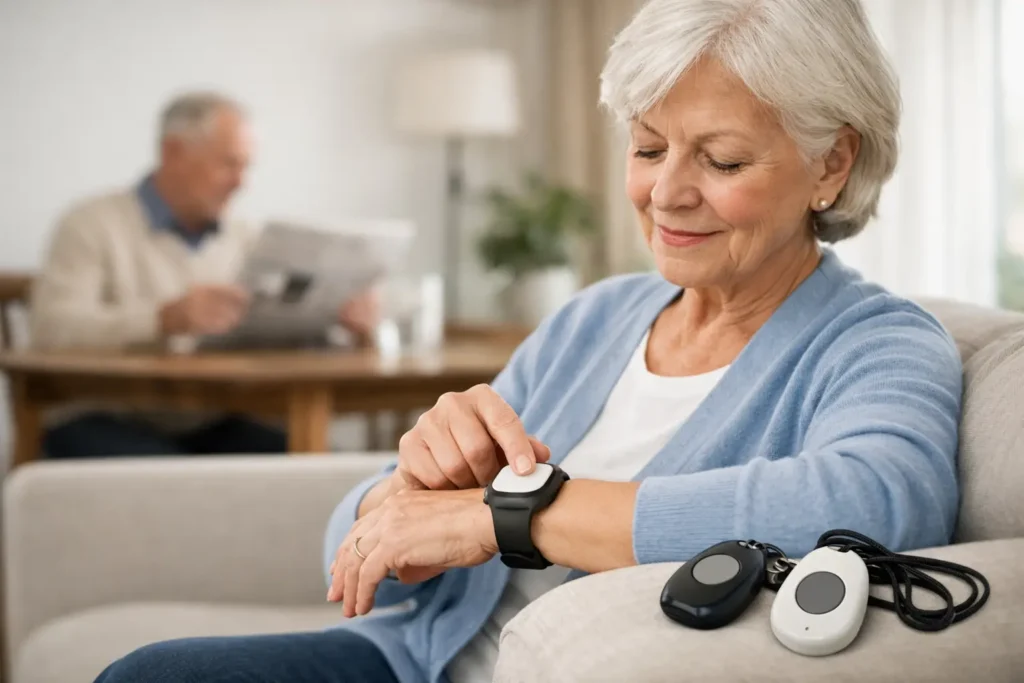
A fall in the bathroom. Sudden dizziness in the garden. Feeling unwell while walking to the shops. These are the moments when wearable emergency alarms can make a practical difference: they give the wearer a simple way to let family, friends or carers know that help is needed.
For many people, the aim is not to make life feel monitored or restricted. It is to continue living at home, following familiar routines and going out with confidence, while knowing that help is at hand if something goes wrong. The right alarm supports independence without asking someone to remember complicated technology, charge another device every night or carry a phone from room to room.
Wearable emergency alarms are small personal safety devices, usually worn on the wrist or around the neck. When the wearer needs help, they can activate an alert that is sent to chosen contacts or a monitoring service, depending on the system.
They are often considered by older people, people living alone, those managing a health condition, and anyone whose mobility or confidence has changed. They can also bring welcome reassurance to families who worry about a loved one being unable to reach the telephone after a fall, illness or distressing event.
The best choice depends on where protection is needed. A traditional pendant alarm may work well inside the home but have limited range beyond it. A wearable with a home base station can offer reliable coverage around the house and garden, while a phone-connected system may extend protection when the wearer is out and about. Some products combine both.
A personal alarm should work in the way that feels most natural for the person wearing it. Not every emergency looks the same, and relying on a single type of alert can leave gaps.
The most familiar option is a button press. A wristband can be especially useful where pressing a button is difficult, as some designs use two sides that are squeezed together. That action can be easier to manage during pain, panic or reduced dexterity.
A manual SOS is valuable for more than falls. It can be used if someone feels faint, experiences chest pain, becomes frightened by an unexpected visitor, or needs assistance but cannot safely get to the phone. The person does not need to explain everything perfectly before the alert is raised. Their nominated contacts simply know to check in and arrange help if necessary.
Some emergencies are not sudden. A person may feel increasingly unwell, become confused, or simply fail to follow their normal routine. Scheduled check-ins create a gentle safety net: at an agreed time, the wearer confirms that they are all right. If they do not respond, the system can alert their support network.
This can suit someone who values privacy but would benefit from a regular prompt. It also gives family members a clear plan, rather than leaving them to wonder whether they should call again or travel across town because they have not heard back.
Automatic fall detection is designed to recognise the movement pattern of a severe fall and raise an alert without the wearer needing to act. It can be particularly helpful if a person is unconscious, injured, disorientated or unable to reach the alarm.
There is a necessary trade-off here. No fall detection technology can identify every fall or understand every circumstance perfectly. A slow slide from a chair, for example, may not look like a severe fall to a device, while some energetic movements may require the wearer to cancel an alert. That is why automatic detection works best alongside a simple manual SOS and regular check-ins, rather than as the only safeguard.
The question is not only whether an alarm works. It is whether it works where life actually happens.
At home, a dedicated base station can give dependable coverage across rooms and into the garden. This matters because falls do not only happen next to a bedside table or in the sitting room. Bathrooms, stairs, kitchens and outside paths can all present risks, and a mobile phone may be charging in another room when it is needed most.
Beyond the home, smartphone connection can extend protection for trips to the shops, visits to friends, appointments and holidays in the UK. The wearer should not have to open an app or navigate a screen to stay protected. If the system uses a phone, the practical requirement is usually to keep it nearby, charged and connected – something families should discuss honestly before choosing a device.
Mobile coverage also matters when travelling. An alarm that uses a phone cannot send a remote alert where there is no usable signal or the phone battery is flat. This does not make it unsuitable, but it does mean that families should choose around real routines, rather than assuming every product offers the same coverage everywhere.
An emergency alarm only helps when it is being worn. That sounds obvious, but comfort and convenience are central to reliable protection.
A device that needs frequent charging may be left on the bedside table. A pendant that feels conspicuous may be removed before visitors arrive. A wristband that cannot be worn in water may be taken off for a shower – one of the places where a fall can be especially serious.
Look for a wearable that fits naturally into the day: waterproof for washing and showering, comfortable enough for bed, and designed for continuous wear. A battery that lasts a full year avoids the regular charging routine that can interrupt protection or become difficult to manage. For someone with a pacemaker, it is also sensible to check that the device is confirmed as pacemaker-safe.
These features are not luxuries. They help turn an alarm from something kept “just in case” into something that is actually there when needed.
Buying a personal alarm can be an emotional conversation. A parent may worry that their children think they can no longer cope. An adult child may fear sounding controlling. The most helpful starting point is autonomy: the alarm is there to support the person’s choices, not take them away.
Talk about the situations that feel most relevant. Is the concern a previous fall? Living alone after a bereavement? A condition that can cause dizziness or confusion? Going for walks without someone close by? The answers will point towards the most useful features.
It is worth checking exactly who receives an alert, what information they receive, whether there are ongoing service costs, and what happens if the first contact does not answer. Ask how the system is set up, whether support is available in the UK, and whether the wearer can test it confidently before relying on it.
Acticheck brings manual SOS alerts, “I’m OK” check-ins and automatic severe-fall detection together in a waterproof wristband designed for year-round wear, with home and phone-based protection for everyday life.
Once an alarm is chosen, take time to make it part of normal life. Wear it in the shower, at night and in the garden if those are the areas it is designed to cover. Agree who the emergency contacts are and make sure they understand what to do when an alert arrives. Test the device at a calm time, so the wearer knows the action without having to learn it during an emergency.
It also helps to review contacts after a change in circumstances. A neighbour may move away, a relative may change their phone number, or someone may no longer be able to respond quickly. A safety plan is strongest when it reflects the people who are genuinely available.
The purpose of a wearable alarm is not to make someone feel fragile. It is to make ordinary life feel possible: a shower without worry, time in the garden, an afternoon out, and the confidence that if help is needed, someone can be told.