

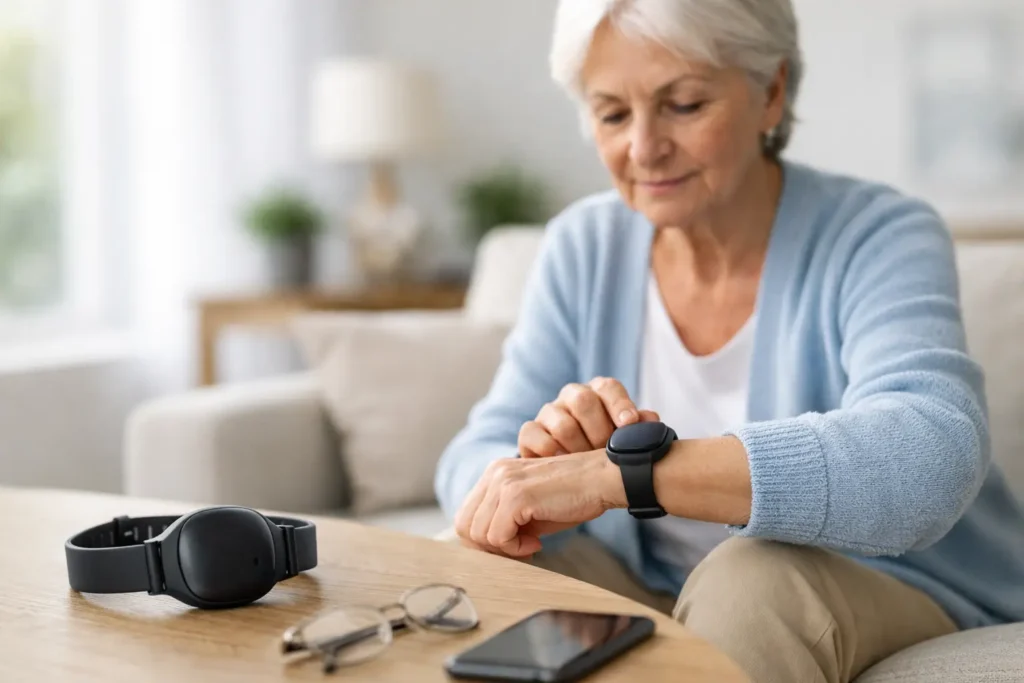
A fall is frightening not only because of the injury it may cause, but because it can leave someone unable to reach a phone, press an alarm or call out. An automatic fall detection wristband is designed for that moment: it can raise an alert after a severe fall, so help can be arranged even when the wearer cannot act for themselves.
For people living independently, this protection should not come at the cost of freedom. The right wristband fits around ordinary life – getting dressed, making a cup of tea, gardening, showering, sleeping and going out – while giving family members reassurance that help is at hand.
A fall-detection wristband uses sensors to recognise the sudden movement and impact pattern associated with a severe fall. When it identifies one, it sends an alert to nominated family members, friends or carers. They can check what has happened and decide whether urgent help is needed.
This matters when a person is unconscious, confused, in pain or simply too far from a phone. It also removes the pressure of remembering to activate an alarm during a frightening event. Whatever happens, wherever it happens, whenever it happens, there should be a way to get a message to the people who care.
Automatic detection is best understood as one layer of protection, not a replacement for every other safety measure. Not every fall has the same movement pattern. A slow slide from a chair, for example, may not look like a sudden, severe fall to a wristband. Equally, a sharp movement in everyday life may need checking before an alert is sent. A dependable system combines automatic fall detection with a simple manual alarm, giving the wearer a clear way to ask for help for a fall, illness, anxiety or any other emergency.
Many personal alarms work well in a particular room, then get taken off to charge or left on a bedside table. Unfortunately, emergencies do not keep to convenient times or places. The bathroom, stairs, garden and bedroom can all be places where a person is alone and vulnerable.
That is why wearability is not a minor detail. A wristband that is waterproof can stay on in the shower, where slips are common. One that is comfortable enough for bed remains available overnight. A battery that lasts a full year avoids the regular charging routine that can leave an alarm unpowered precisely when it is needed.
Look for a design that is also suitable for people with a pacemaker and simple enough to use without confidence in technology. If calling for help involves finding a touchscreen, entering a code or remembering several steps, it may be difficult to use under stress. A clear action, such as squeezing buttons on the wristband, is easier to remember and easier to do.
Home protection should cover more than the sitting room. A base station can provide reliable connection around the home and garden, without relying on the wearer to carry a mobile phone from room to room. This is especially valuable for someone who enjoys tending plants, putting out washing or walking to the shed.
Before choosing a service, ask how the alert reaches the people who need to know, how far the wristband works from its home base station, and what happens if the mains power or broadband is interrupted. The practical details make a real difference to day-to-day confidence.
Independence also includes visiting friends, going to appointments, taking the dog out or enjoying a holiday. For protection away from home, some systems use a smartphone connection. The wearer does not need to operate the app during an emergency, but they do need to keep their compatible phone nearby and connected.
This is a sensible trade-off for many people. It extends support beyond the house without turning the wristband into a complicated device. It is worth being honest about routines, though. If someone rarely takes a phone out with them, or often lets its battery run flat, an out-of-home solution needs careful consideration.
Falls are only one reason a person may be unable to get help. Someone may feel suddenly unwell, have chest pain, become disorientated or simply need reassurance after a scare. A wristband is most useful when it covers these different situations without making everyday life feel medicalised.
A strong approach brings together three actions. First, the wearer can trigger an SOS manually by squeezing the wristband buttons. This is for any situation where they know they need help. Second, scheduled “I’m OK” check-ins provide a gentle prompt to confirm that all is well. If a check-in is missed, the chosen contacts are informed, which can be particularly reassuring for families who do not live nearby.
Third, automatic severe-fall detection offers a safety net when the wearer cannot press anything at all. Together, these features protect against a wider range of concerns than a pendant alarm that depends solely on being pressed.
The point is not to monitor every movement or take decisions away from the wearer. It is to make sure a change in routine, a missed response or an emergency is less likely to go unnoticed. For many families, that means fewer anxious calls and more confidence to let a loved one continue living on their own terms.
Start with the person’s actual routine rather than a list of technical features. Do they shower independently? Sleep alone? Spend time in the garden? Go out with a mobile phone? Have they had previous falls, balance problems, fainting episodes or a condition that could make it hard to call for help?
Then consider who will receive alerts. Nominated contacts need to be willing and able to respond. It helps to agree in advance what they should do if an alert comes through: call the wearer first, contact a neighbour, or arrange emergency assistance if there is no response. A simple plan prevents uncertainty at the moment it matters most.
Also ask whether the service has ongoing costs, whether the wristband needs frequent charging, and how easy it is to set up and support. The best technology is the technology that remains worn, switched on and understood. An award-winning technology-enabled care service such as Acticheck is built around this principle, combining home coverage with smartphone-supported protection when out, without asking the wearer to manage a complex device.
It can be difficult to raise the subject of falls with a parent, partner or friend. They may worry that accepting an alarm means giving up independence. A better conversation focuses on what they want to keep doing: showering without someone waiting outside, tending the garden, staying in their own home and seeing people when they choose.
A wristband should support those choices rather than signal frailty. It is there quietly in the background, ready for the rare occasion when plans change. Give the wearer a say in its colour, comfort, contacts and check-in routine. That sense of control makes it far more likely to become part of everyday life.
The most reassuring safety aid is often the one a person forgets they are wearing – until they need it. Choose protection that stays on through the ordinary moments, because those ordinary moments are exactly what independent living is for.