

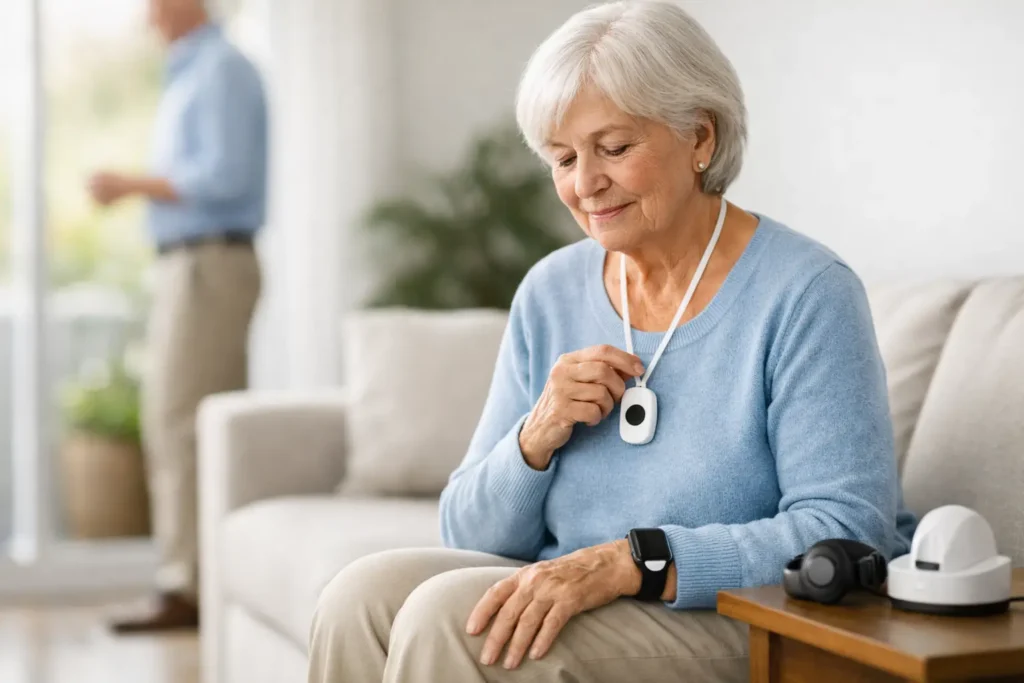
A fall can happen in the few quiet moments when nobody is nearby: getting out of bed at night, stepping into the shower, reaching for something in the garden or walking home from the shops. An elderly fall alarm is there for the gap between an emergency happening and someone knowing help is needed. For the person wearing it, that can mean more confidence to carry on with everyday life. For family, it means less worry about an unanswered phone or a missed call.
The right alarm should not make independence feel like a compromise. It should be simple enough to wear without thinking about it, dependable when the wearer cannot reach a phone, and practical for the places where life actually happens.
A fall alarm is a personal safety device designed to raise an alert when someone needs help. Some have a button the wearer presses during an emergency. Others can also detect certain serious falls automatically. The best choice often combines both, because not every emergency is a fall and not every fall can be detected in the same way.
A manual SOS alert matters if someone feels suddenly unwell, becomes breathless, has chest pain, is frightened by an intruder or has fallen but can still move their hands. It gives them a clear action to take: press or squeeze the alarm to tell their chosen contacts that help is needed.
Automatic fall detection is for the more difficult scenario: a serious impact followed by little or no movement, when the wearer may be unconscious, confused or unable to operate the alarm. It can provide an extra layer of protection, but it should never be presented as a guarantee that every fall will be recognised. A gradual slide to the floor, a fall onto a soft surface or a person moving after a fall may not trigger every device. That is why an easy manual alert and a regular check-in feature can be just as valuable.
An alarm left on a bedside table cannot help in the bathroom. A device removed for charging cannot help overnight. And an alarm that only works in one room may offer little reassurance to someone who enjoys their garden, visits friends or goes out independently.
When comparing options, start with the wearer’s normal routine. Think about where they spend time, rather than only the most obvious risks. A good elderly fall alarm should be comfortable enough for everyday wear, including in bed and in the shower if that is where protection is needed. Bathrooms are a common place for falls, so waterproofing is more than a nice extra.
At home, some systems use a base station to provide coverage around the house and garden. This can be especially useful where a mobile phone is not always kept in a pocket, or where reliable protection indoors matters most. Away from home, an app-connected system can extend safety while the wearer is walking, visiting family, on holiday in the UK or simply popping out for milk. The practical question is not whether an alarm has an app. It is whether it continues working without requiring the wearer to find, open and operate that app in an emergency.
For many people, wearing a wristband is the easiest option. It is visible, familiar and difficult to misplace. It also needs to feel like an ordinary part of getting dressed, not another task to remember.
Families often worry most when something is unusual. Mum has not answered her phone. Dad has not opened a message. A neighbour has not seen them as expected. None of these moments necessarily means an emergency, but uncertainty can quickly become distressing.
Scheduled “I’m OK” check-ins offer a calm, practical answer. At an agreed time, the wearer confirms they are alright. If they do not respond, their family or care network can be notified to check in. This is not about watching over someone’s every move. It is about agreeing on a simple routine that respects privacy while making sure a missed check-in does not go unnoticed.
Check-ins are particularly helpful for people who live alone, have a long-term condition that can cause sudden illness, or are recovering after a hospital stay. They can also be reassuring when a relative lives some distance away and cannot easily call round.
The details determine whether an alarm will be worn consistently and whether it will work when it is needed. Before buying, consider how the wearer will use it in real life.
First, ask what happens after an alert. Does it notify family members, a professional monitoring service or both? Are several people able to receive an alert, so responsibility does not fall on one relative? Make sure everyone understands what they are expected to do if they are notified, particularly if they live far away.
Next, consider charging. Frequent charging can be a weak point for any safety device. A device is no use if its battery is flat, or if it is taken off overnight and forgotten in a drawer. A long battery life removes one of the biggest daily burdens. Acticheck’s wearable wristband, for example, is designed to run for a full year without recharging, helping it remain on the wrist through ordinary routines.
Also check comfort and compatibility. If the wearer has a pacemaker or other medical device, confirm that the alarm is suitable. If they dislike necklaces or have arthritis in their fingers, assess whether the SOS action is genuinely easy for them. A simple squeeze may be more manageable than a small button, complicated screen or multi-step call process.
Finally, be clear about coverage and ongoing costs. Some alarms depend entirely on a phone being close by. Others have a home base station as well as smartphone support for time away from home. Ask whether there is a subscription, what is included, and what happens if mobile signal is limited. Honest answers make it easier to choose a service that fits both the household and the budget.
Technology can shorten the time between a fall and an alert, but it works best as part of a wider safety plan. Keep frequently used items within easy reach. Remove loose rugs and trailing cables. Make sure hallways and stairs are well lit, especially at night. Encourage a GP, pharmacist or clinician review if falls are becoming more frequent, as medicines, eyesight, balance problems and dehydration can all play a part.
It also helps to agree what family should do after receiving an alert. A nearby contact may be able to call immediately or visit. If there is reason to believe someone is seriously injured, unconscious or in immediate danger, call 999. A fall should not be treated as minor simply because the person says they are embarrassed or does not want to cause a fuss. Pain, head injuries and the effects of a long time spent on the floor can become serious.
The aim is not to make someone feel monitored. It is to make it easier for them to ask for help without having to reach a phone, explain a complicated device or wait in discomfort. That distinction protects dignity as much as safety.
Choosing an alarm can feel like an emotional step. The wearer may see it as a reminder of a recent fall or changing health. Adult children may worry that suggesting one sounds controlling. The conversation is usually easier when it starts with freedom, not fear.
An elderly fall alarm can support a person who wants to keep sleeping in their own bed, taking the dog into the garden, having a shower in peace and seeing friends without constant check-in calls. It gives family a sensible backup for the moments when the unexpected happens. Whatever happens, wherever it happens, whenever it happens, help should be within reach.
The most useful alarm is the one that is worn every day, understood by everyone involved and trusted when it matters. Choose for the person’s routine, not just the specification sheet, and let the device quietly do its job while life carries on.