

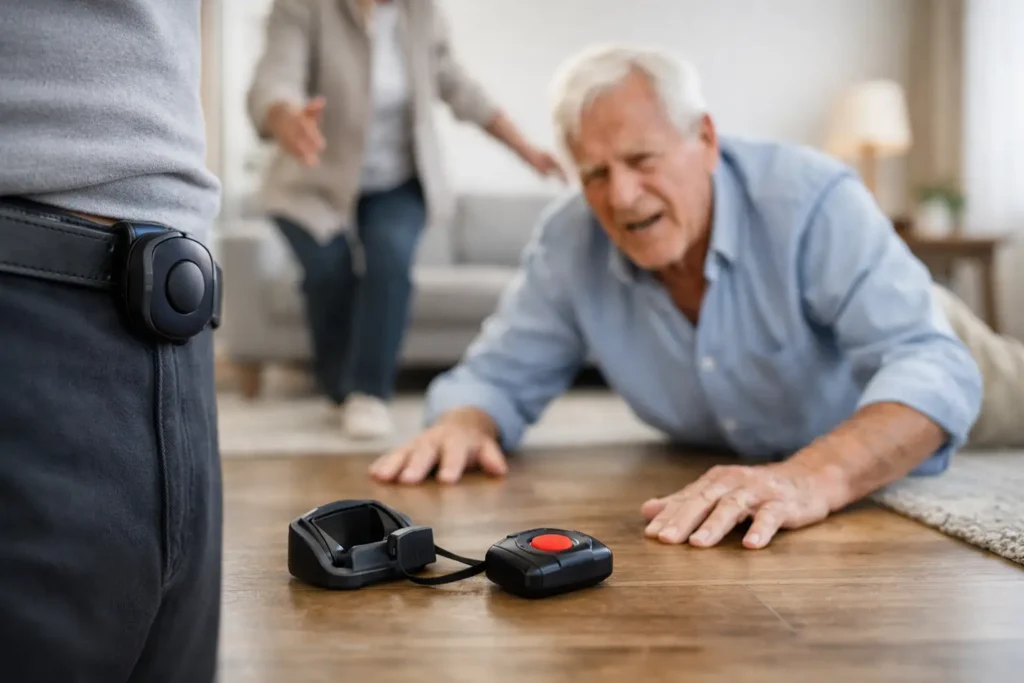
A fall alarm for Parkinson’s disease is not about taking over someone’s life. It is about making sure help can be called if a fall, sudden illness or moment of distress leaves them unable to reach a telephone. For someone living independently, and for the family worrying quietly in the background, that can make a difficult day feel more manageable.
Parkinson’s affects people differently. Some people may have little difficulty with balance for many years, while others experience freezing, shuffling steps, dizziness, changes in blood pressure or reduced confidence when turning and moving around the home. A useful alarm should fit the person’s real routine, not ask them to change it.
Falls are not an inevitable part of Parkinson’s disease, but the risk can increase as symptoms change. A person may freeze in a doorway, lose balance while turning, feel light-headed when standing up, or be less steady when medication is wearing off. Fatigue, poor sleep and a rush to the bathroom can add to the risk.
The consequences are not only physical. After a fall, many people begin avoiding the garden, the stairs or trips to the shops because they fear being left without help. Family members can feel the same concern, especially when they do not live nearby or cannot call in every day.
A personal alarm cannot prevent every fall. It can, however, provide a practical route to alert trusted family, friends or carers when someone needs help. That means support can be organised sooner, rather than relying on the person being able to crawl to a telephone or wait until someone happens to visit.
The right choice depends on the wearer, their symptoms and where they spend time. But a dependable system should cover more than one type of emergency.
First, it should be easy to call for help deliberately. After a trip or near-fall, a person may be shaken but not badly injured. They may simply need a relative to come over, a neighbour to check in or someone to arrange further help. An alarm that can be activated with a simple, familiar action is often more useful than a device with several menus or a small screen.
Second, automatic fall detection can offer another layer of protection. A severe fall may leave someone unconscious, confused, in pain or unable to press a button. Detection technology looks for the movement pattern associated with a serious fall and can raise an alert if the wearer cannot respond. This is valuable protection, but it should not be treated as a guarantee that every fall will be recognised. Slower slips, a controlled descent to the floor and some Parkinson’s-related movements may not trigger an automatic alert.
Third, regular check-ins can be especially reassuring. A scheduled prompt to confirm “I’m OK” gives the wearer a straightforward way to show that all is well. If they do not respond, their chosen contacts can be told to check in. This can be helpful when symptoms fluctuate, after a medication change, or when someone has had a recent fall and the family wants additional reassurance without making repeated phone calls.
A fall alarm is only useful when it is being worn. That sounds obvious, but many alarms are taken off for charging, showering or sleeping – precisely when a person may be alone and vulnerable.
Think through the ordinary day. Is the device comfortable enough to wear in bed? Is it waterproof for the bathroom and shower? Does it work in the garden as well as the living room? Will it still protect the wearer during a visit to family, a walk with a companion or a holiday in the UK?
At home, a base station can provide reliable coverage around the house and garden, without expecting the wearer to keep a mobile phone on them from room to room. Away from home, some systems use a smartphone connection, so the mobile phone needs to be nearby and switched on. This is a sensible trade-off for people who already carry a mobile, but it is worth discussing honestly with the person who will wear the alarm.
The best arrangement is usually the one that asks the least of them. If charging is difficult to remember, choose a device designed for long battery life. If hands are affected by tremor or stiffness, test whether the emergency action is easy to use. If the person dislikes necklaces, a wrist-worn option may be more acceptable. Consistent wear matters more than a long list of features that never become part of daily life.
It is tempting to look for a device that will do everything automatically. Yet a manual SOS function remains essential. Not every emergency involves a fall: chest pain, sudden weakness, breathlessness, a frightening spell of dizziness or being unable to get up from a chair can all create a need for help.
A wristband that lets the wearer squeeze buttons to raise an alert is simple to understand and can be used without looking at a screen. This may suit people whose movement or dexterity varies through the day. It also keeps control with the wearer. They decide when something is wrong and when they want someone to know.
Automatic detection adds protection for the occasions when they cannot decide or cannot act. Scheduled check-ins add a further safety net for the quieter concern that something may be wrong but no emergency alert has been raised. Together, these features acknowledge a basic reality of Parkinson’s: no two days, and no two incidents, look exactly alike.
An alarm is only as helpful as the plan behind it. Before relying on one, agree who should receive alerts and what they should do. A nearby relative may be able to reach the home quickly, while another family member may be best placed to make calls, speak to services or keep everyone informed.
Make sure contacts understand the difference between an SOS alert, an unconfirmed check-in and an automatic fall alert. They should know the person’s address, how to access the property if appropriate, and any relevant details such as mobility needs, medication or communication difficulties. Keep this information current if routines or care needs change.
It also helps to have a calm conversation with the wearer. Explain that using the alarm is not “making a fuss”. It is a sensible way to ask for support early, before a small problem becomes a bigger one. Practise the action once or twice so it feels familiar, then let the alarm become an unobtrusive part of everyday life.
When comparing alarms, focus on the circumstances that are most likely to matter. Ask whether it can be worn in the shower and overnight, whether it covers the garden, how it works away from home, and whether it needs frequent charging. Check who receives alerts and whether the family can choose and update those contacts.
Also ask how the system handles a detected fall. Can the wearer cancel an alert if they are safe? What happens if they do not respond? Clear answers reduce uncertainty for everyone.
For many families, a wearable such as Acticheck is appealing because it combines a simple squeeze SOS, scheduled “I’m OK” check-ins and automatic severe-fall detection in a waterproof wristband that can be worn day and night. Its home base station covers the home and garden, while a connected smartphone extends protection outside the home. A one-year battery also removes the regular charging routine that can otherwise leave an alarm sitting on a bedside table.
The purpose of a fall alarm is not to turn a person with Parkinson’s into a patient under constant observation. It is to give them a dependable way to call for help while continuing to make their own choices – whether that is showering independently, sitting in the garden, sleeping without removing an alarm or going out with their mobile phone nearby.
Symptoms may change, confidence may dip and family circumstances may shift. Revisit the safety plan when they do. The most reassuring alarm is the one that is comfortable enough to be worn, simple enough to be used under pressure and ready whenever help is needed.