

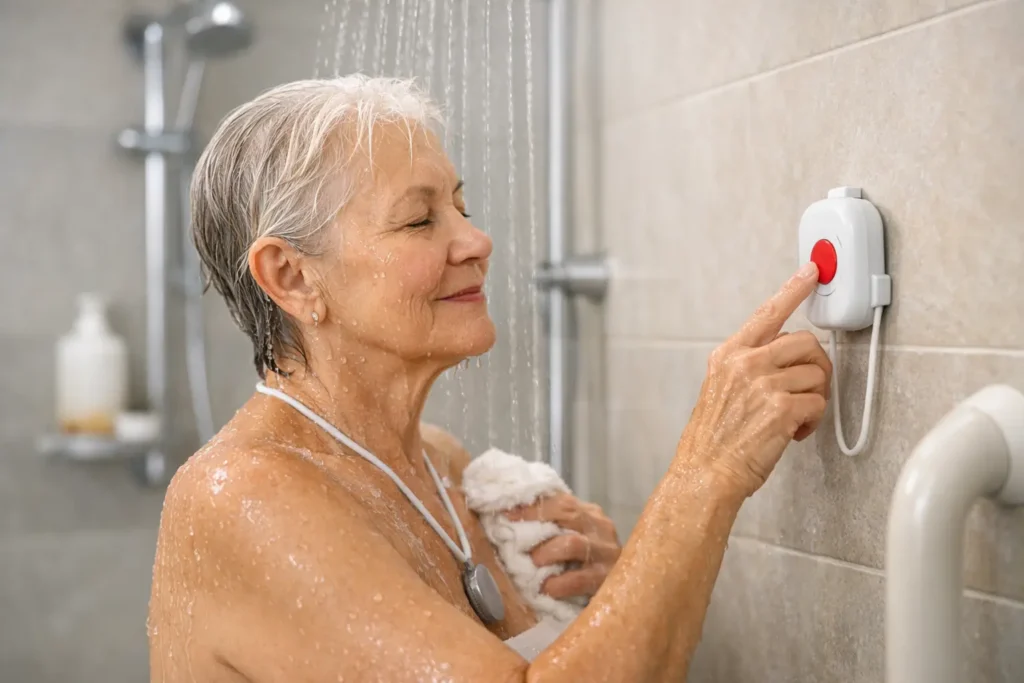
The bathroom is often where a short loss of balance becomes a serious concern. Wet tiles, a slippery shower tray and the effort of stepping in or out can make it difficult to get back up after a fall. A personal alarm for showering means help can still be called for, without leaving a device on a shelf outside the room.
For many people, the concern is not only falling. Sudden dizziness, breathlessness, weakness or feeling unwell can happen without warning. Being able to summon support while keeping the door closed and dignity intact can make a meaningful difference to confidence at home.
Most people do not want a shower to feel like a supervised activity. They want to continue their normal routine, on their own terms. But bathrooms create a particular gap in many personal alarm arrangements: a pendant may be taken off to avoid getting it wet, a mobile phone may be left charging in another room, or an alarm button may be too far away to reach.
That gap matters because getting up after a fall is not always safe. Even if there is no obvious injury, someone may feel shaken, confused or unable to put weight on a leg. Trying to manage alone can lead to another fall or make an injury worse.
A wearable alarm that remains on the wrist during washing removes one extra decision from the day. There is no need to remember to put it back on after a shower, or to worry about whether it has been charged. Protection is simply there when it is needed.
This also helps families. A son, daughter, friend or neighbour cannot be present for every daily routine, nor should they have to be. The right support can offer reassurance while allowing the wearer to remain independent.
The first requirement is straightforward: it must be suitable to wear in the shower. Do not assume that every personal alarm is. Some devices are only splash-resistant, while others have restrictions around immersion, soaps or hot environments. Check the manufacturer’s guidance carefully before relying on an alarm in the bathroom.
It should also be easy to activate when someone is worried, injured or flustered. Small buttons, complicated menus and a device that has to be found and put on can all create difficulty in an emergency. A wrist-worn alarm is close at hand, even if someone is sitting on the shower floor or cannot reach a phone.
A practical system should cover more than one type of event. A manual SOS alert is essential, because the wearer knows when they need help. Some systems also provide scheduled check-ins, allowing the wearer to confirm that they are OK at an agreed time. Automatic fall detection can add another layer of protection if a severe fall prevents someone from pressing the alarm.
Fall detection is helpful, but it should not replace a manual call for help. Not every fall can be recognised automatically, and not every emergency involves a fall. The best arrangement gives the wearer a simple way to raise an alert themselves, while providing additional protection if they cannot.
A shower-safe wristband is only useful if the wider alarm system can send the alert reliably. At home, this may mean a base station that provides coverage across the house and garden, rather than relying on a mobile phone left in a particular room.
When out and about, some modern systems can use a nearby smartphone connection to extend protection beyond the home. This can be valuable for walks, visits, holidays and everyday errands. It does depend on the phone being nearby and connected, so it is worth understanding exactly how out-of-home coverage works before choosing a service.
The bathroom itself can be a challenging place for a signal, particularly in older properties with thick walls. Ask whether the provider will help you understand the likely coverage in your home and what happens if the connection is interrupted.
An alarm cannot help if it is sitting in a charging cradle. Frequent charging is easy to forget, especially for someone managing medication, appointments and a busy household. It can also encourage people to take a wristband off overnight or before a shower, precisely when they may need it.
A long battery life supports a more dependable routine. Acticheck’s waterproof, pacemaker-safe wristband, for example, is designed to be worn in bed and in the shower and operates for a full year without recharging. That reduces one common source of worry for both the wearer and their family.
There is no single answer for every household. Someone who is steady on their feet but occasionally becomes unwell may primarily want a straightforward SOS alert. Someone with a history of serious falls may value automatic fall detection as well. A person living with memory difficulties may benefit from a system that is simple to wear continuously and includes regular check-ins.
Before deciding, consider these practical questions:
It is equally important to discuss the response plan. An alert is only as useful as the people who receive it and know what to do next. Families may choose relatives, friends, neighbours or a professional monitoring arrangement, depending on their circumstances. Agree who has a key, who can arrive quickly, when to call emergency services and how to contact other family members.
This conversation can feel uncomfortable at first. Framing it around choice usually helps. The aim is not to take control away from someone, but to make it easier for them to continue doing ordinary things with greater confidence.
A personal alarm is a safety net, not a substitute for sensible bathroom changes. If falls or near-misses have happened before, an occupational therapist, GP or other healthcare professional may be able to advise on the underlying causes and suitable adaptations.
Small changes can reduce risk: non-slip flooring or a securely fitted mat, grab rails installed in the right position, a shower seat where standing is tiring, good lighting and a clear path between the bedroom and bathroom. Avoid loose rugs and keep toiletries within easy reach so there is less stretching or twisting on wet surfaces.
It is also worth thinking about the shower routine itself. Rushing, showering when tired or standing up too quickly after washing hair can all increase the chance of feeling unsteady. Taking a little more time is not giving up independence. It is a practical way to protect it.
Some people resist a personal alarm because they associate it with losing freedom. In practice, a well-chosen wristband can do the opposite. It can make it easier to shower with the door closed, sleep without a phone on the bedside table, spend time in the garden or leave the house knowing that help is at hand.
The best personal alarm for showering is one the wearer will genuinely keep on. It should feel comfortable, simple and unobtrusive enough to become part of daily life. When protection is there whatever happens, wherever it happens and whenever it happens, you and your family can focus less on what might go wrong and more on living well at home.