

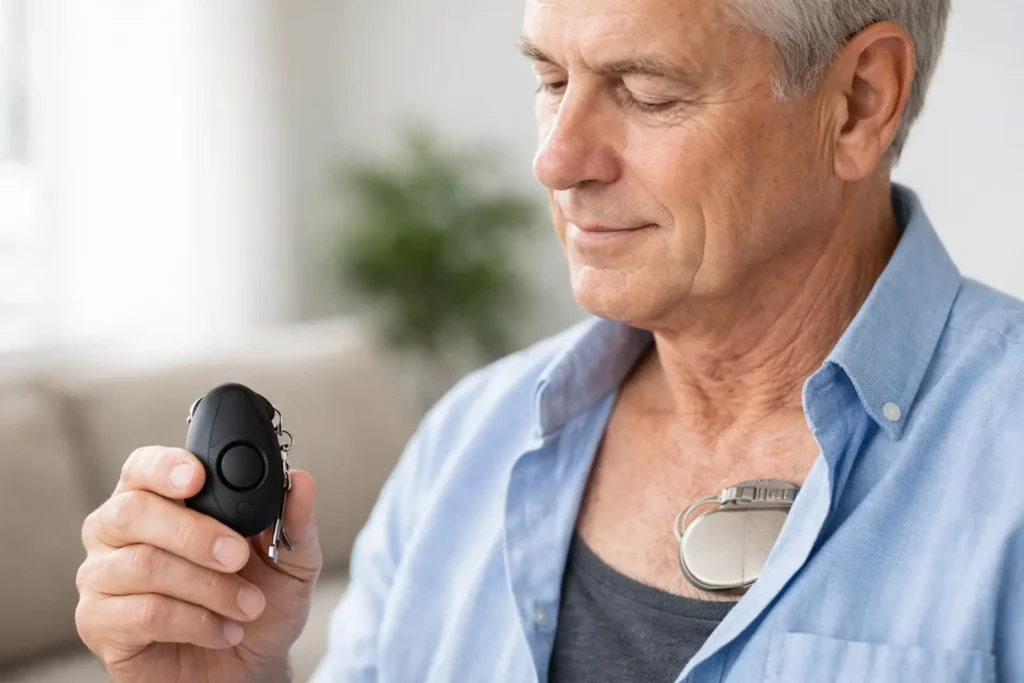
A fall in the kitchen, a sudden spell of dizziness in the garden or feeling unwell during the night can be frightening when you live alone. If you are looking for a personal alarm safe with a pacemaker, you need clear reassurance without guessing. The alarm should help you summon support simply, while respecting the guidance that keeps your implanted heart device working as it should.
For most people, a suitable wearable alarm can be part of everyday protection. But it is sensible to check the alarm manufacturer’s advice, follow the instructions for your particular pacemaker or implantable cardioverter defibrillator (ICD), and ask your cardiac team if you have any uncertainty. A few practical checks can provide confidence for you and reassurance for your family.
Personal alarms commonly use low-power wireless signals to communicate with a base station or a mobile phone. Like mobile phones, headphones and other everyday electronics, they can produce electromagnetic fields. In unusual circumstances, a strong field or a device held very close to an implanted cardiac device could cause interference.
That does not mean every wireless alarm is unsuitable. It means the design matters, as does how it is worn and used. A wrist-worn alarm sits away from the chest, where a pacemaker is usually implanted. This can be a more comfortable and practical position than carrying a transmitting device in a shirt or breast pocket.
The term “pacemaker” is also often used broadly. Some people have an ICD, a cardiac resynchronisation therapy device, or another implanted cardiac device with its own instructions. Do not assume that advice for a relative’s implant automatically applies to yours. The clinic that manages your device can confirm any individual precautions.
Interference is not usually something you would be expected to diagnose at home. Your implanted device is designed to be checked regularly, and manufacturers provide guidance on everyday electronic equipment. If you feel unwell, notice palpitations, dizziness or any symptom that concerns you while using an electronic device, move it away and seek medical advice.
For an alarm, the key issue is prevention: choose a product specifically stated to be suitable for pacemaker users, use it as directed, and avoid improvising with unapproved accessories or chargers close to the implant site.
A pendant alarm can be useful, but many are worn on a cord over the chest. For someone with a pacemaker, that position may prompt understandable questions about proximity. A wristband keeps the alarm accessible on the arm, where it can be pressed easily after a fall or when sitting down.
It also removes a common daily problem: pendants are often taken off for washing, sleeping or changing clothes. Protection only helps when it is being worn. A waterproof wristband that stays on in bed and in the shower can reduce those unprotected gaps.
Start with the manufacturer’s explicit safety information. Look for a clear statement that the wearable is pacemaker-safe, rather than relying on a general assumption that all alarms are alike. If you are comparing products, ask how the alarm communicates, where it is worn and whether it needs regular charging.
These four checks are particularly useful before you decide:
Battery life deserves more attention than it often receives. A rechargeable alarm may sound reassuring when first purchased, but it cannot protect someone while it is on a bedside table waiting to be charged. For people managing a heart condition, mobility difficulties or memory problems, a device that needs little day-to-day attention is often the safer choice.
Acticheck’s wearable wristband is pacemaker-safe and designed for continuous use. It is waterproof, can be worn in bed and in the shower, and runs for a full year without recharging. At home, it works with a base station to provide coverage around the home and garden. When out, the wearer can remain protected through an Android or iPhone connection, provided their mobile phone is nearby.
The best alarm is one that fits ordinary life. Someone may not have the strength or confidence to find a mobile phone after a fall. They may feel faint, be in pain or simply be unable to reach a pendant that has slipped under their clothing. That is why several ways to raise concern can be more useful than one button alone.
A manual SOS function lets the wearer call for help when they know they need it. With a wristband, this should be simple enough to use under stress, such as squeezing the buttons. Scheduled “I’m OK” check-ins provide another safety net for someone who may be unwell but has not fallen. Automatic severe fall detection can add protection when a person cannot activate the alarm themselves.
There is a necessary limit to any fall-detection system: no technology can identify every fall, illness or emergency perfectly. A gradual slide from a chair, a collapse without a heavy impact, or feeling suddenly breathless may not trigger an automatic alert. That is why manual alerts and check-ins matter alongside fall detection, not as an afterthought.
For families, this combination can ease the pressure of having to telephone repeatedly just to make sure everything is all right. The wearer keeps their independence and routine, while the people who care about them have a practical route to be alerted if something is wrong.
Keep following the advice given by your pacemaker clinic, especially about mobile phones and other transmitting equipment. A mobile phone is generally best kept out of a breast pocket over the implant, and a family member should not place a mobile phone or charging device directly against that area during a visit.
With a wrist alarm, wear it normally on your wrist rather than holding it against your chest. Keep the supplied base station in the recommended position at home. It is there to provide reliable alarm coverage, not to be carried around or placed beside the pacemaker while you sleep.
If you use app-based protection away from home, keep the mobile phone with you as instructed. The app should support the alarm in the background, rather than asking the wearer to navigate a screen during an emergency. Before relying on any new alarm, test it with the people who will respond. Make sure they know what an alert looks like, what information they will receive and what they should do next.
A good supplier should answer practical questions plainly. Ask whether the alarm is suitable for your type of implanted device, whether it works through a home base station, and whether it has coverage in the garden as well as indoors. If the person wears glasses, has arthritis or reduced hand strength, ask how the SOS action works in practice.
It is also worth asking who receives alerts and what happens if they do not respond. An alarm arrangement should suit the real care network, whether that is an adult child nearby, a neighbour, a friend or several relatives sharing responsibility. Agreeing this before an emergency avoids confusion later.
If you have recently had a pacemaker fitted, bring the alarm question to your next device check-up. Take the product name and its safety information with you. Your cardiac team can give advice based on your own implant and health needs, not a one-size-fits-all answer.
Independent living should not mean facing an emergency alone. With a pacemaker-safe alarm that is comfortable enough to wear every day, help can be at hand without taking away the routines that make home feel like home.