
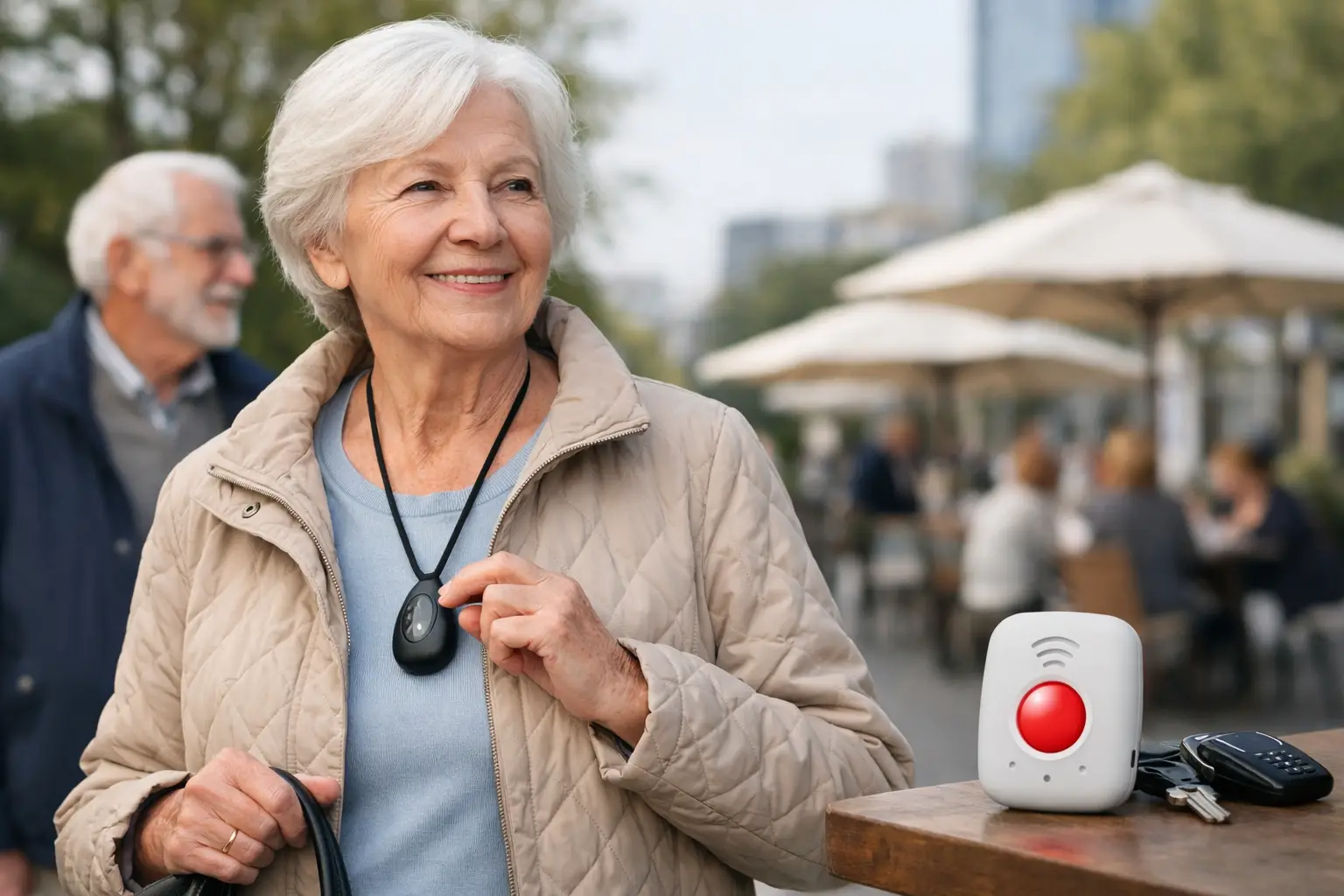
A trip to the shops, lunch with friends or a few days staying with family should not mean leaving safety behind. An elderly alarm away from home can provide vital reassurance when someone lives independently but may need help after a fall, sudden illness or moment of distress.
The right solution should support ordinary life, rather than make every outing feel like a risk assessment. It needs to be simple enough to wear every day, dependable when it matters and designed around the reality that a person may not be able to reach or operate a phone in an emergency.
Why protection away from home matters
Many personal alarms work well within a house because they connect to a base unit. That can be valuable for safety in the bedroom, bathroom, garden and around the home. But the risk does not stop at the front door.
A fall on the pavement, dizziness in a café, chest pain while visiting a friend or confusion in an unfamiliar place can all leave a person needing support. Family members may also worry more when their relative is out alone because they cannot easily tell whether everything is all right.
This is not about stopping someone from going out. For many older people, keeping regular routines, seeing people and making their own decisions is a large part of staying well. The purpose of an alarm is to make those everyday freedoms feel more manageable for everyone involved.
What an elderly alarm away from home needs to do
An alarm for use beyond the home is not simply a pendant with a longer range. It must have a reliable way to send an alert when the wearer is away from their home base station, usually through a nearby mobile phone and an app connection.
The key question is simple: if the wearer needs help while out, what happens next? A good system should alert the people chosen by the wearer or their family, so they can check what is wrong and arrange the right response. Depending on the situation, that might mean calling the person, contacting someone nearby or calling emergency services.
It should also work without turning the wearer into a technician. In an emergency, small buttons, menus, passwords and charging cables can all become barriers. A wearable alarm should be easy to activate through a clear physical action, such as squeezing buttons on the wristband. The wearer should know what to do without having to remember a sequence of steps.
Automatic fall detection can add another layer of protection. A serious fall may leave someone unconscious, confused or in too much pain to press an alarm. No fall-detection system can identify every stumble or every medical emergency, and it should never replace calling 999 where urgent medical help is needed. But it can be especially useful when a severe fall means the wearer cannot summon help themselves.
Regular check-ins are helpful for a different reason. A scheduled prompt to confirm “I’m OK” can provide reassurance even when there has been no fall and no need to press an SOS alert. If a check-in is missed, nominated contacts can be alerted to follow up. This can be particularly useful on days when a loved one is travelling, feeling unwell or spending time alone.
The phone is part of the safety plan
For many alarms that work away from home, the wearer needs to take a compatible smartphone with them and keep it nearby. This is an important practical point to understand before choosing a system.
The phone provides the connection that allows alerts to be sent beyond the range of the home base station. It should be charged, switched on and carried in a pocket, handbag or coat. The wearer does not need to be constantly looking at it or operating an app, but it must be close enough to maintain the connection.
This approach can be a sensible fit for someone who already takes a phone with them. It avoids the need for another device, another contract or another item to remember. However, it may not suit a person who rarely carries a mobile phone, struggles to keep one charged or is often in places with poor mobile signal.
It is worth discussing this honestly as a family. The best alarm is not necessarily the one with the longest list of features. It is the one a person is comfortable wearing, understands how to use and can rely on as part of their usual routine.
Consider the whole day, not just the outing
An alarm is only useful when it is being worn. That is why comfort, battery life and water resistance matter as much as the alert feature itself.
A wrist-worn device may be easier to keep on than a pendant that is taken off for washing, sleeping or changing clothes. Shower-safe protection matters because bathrooms are a common place for falls, while wearing an alarm in bed can provide reassurance overnight. A long battery life also removes a frequent point of failure. If a device needs charging every day or two, it can easily be left on a bedside table just when it is needed.
Acticheck is designed around this continuous protection. Its wristband can be worn in bed and in the shower, has a battery life of up to a year and provides manual SOS alerts, scheduled “I’m OK” check-ins and automatic severe fall detection. At home, its base station supports coverage around the house and garden. Away from home, the Android or iPhone app extends protection when the wearer keeps their phone nearby.
The aim is not to make someone feel watched. It is to make help easier to reach, whatever happens, wherever it happens, whenever it happens.
Think through real-life situations before you choose
It helps to picture the ordinary journeys the wearer makes. Someone who walks to local shops may need something light and unobtrusive that works with the phone they already carry. Someone who regularly visits family may value check-ins, so relatives know they arrived safely or can follow up if a prompt is missed.
For a person with a known risk of falls, automatic detection may be more important. For someone managing a heart condition, diabetes or episodes of faintness, the ability to send an SOS alert quickly may be the priority. A person living with early memory difficulties may need a device with fewer actions to remember and a routine that family can support.
Holidays and overnight stays deserve a separate conversation. Ask whether the device will work away from the home base station, whether the phone connection will be available and who should receive alerts while the wearer is away. If travelling abroad, check the specific mobile connection and roaming arrangements in advance. It is better to know the limits before setting off than to make assumptions during an emergency.
Set up the people side properly
Technology is only one part of the arrangement. An alarm is most reassuring when the nominated contacts know what an alert means and have agreed how they will respond.
Choose people who are likely to notice their phone and act calmly. They may be a daughter, son, neighbour, friend or carer. Make sure everyone understands the difference between an SOS alert, a missed check-in and a suspected fall, and agree what should happen first. In a life-threatening emergency, the priority is always to call 999.
Review contact details occasionally, particularly after a change in family circumstances, a house move or a new phone number. It is also sensible to practise an alert once the alarm arrives. A short test can remove uncertainty and give the wearer confidence that help is genuinely at hand.
Independence should not end at the doorstep
Choosing an alarm for outside the home is not about predicting the worst. It is about reducing the gap between an emergency and someone knowing about it.
For the wearer, that can mean more confidence to keep going to familiar places and seeing the people who matter. For family, it can mean less time spent wondering whether they should call again or whether a missed message means something is wrong. A dependable alarm cannot remove every risk, but it can make it far easier to ask for help when it is needed most.
The most helpful choice is one that fits naturally into daily life: worn without fuss, supported by a phone when out, and backed by people who know what to do. That way, a visit, a walk or a holiday can remain what it should be – part of an independent life.