

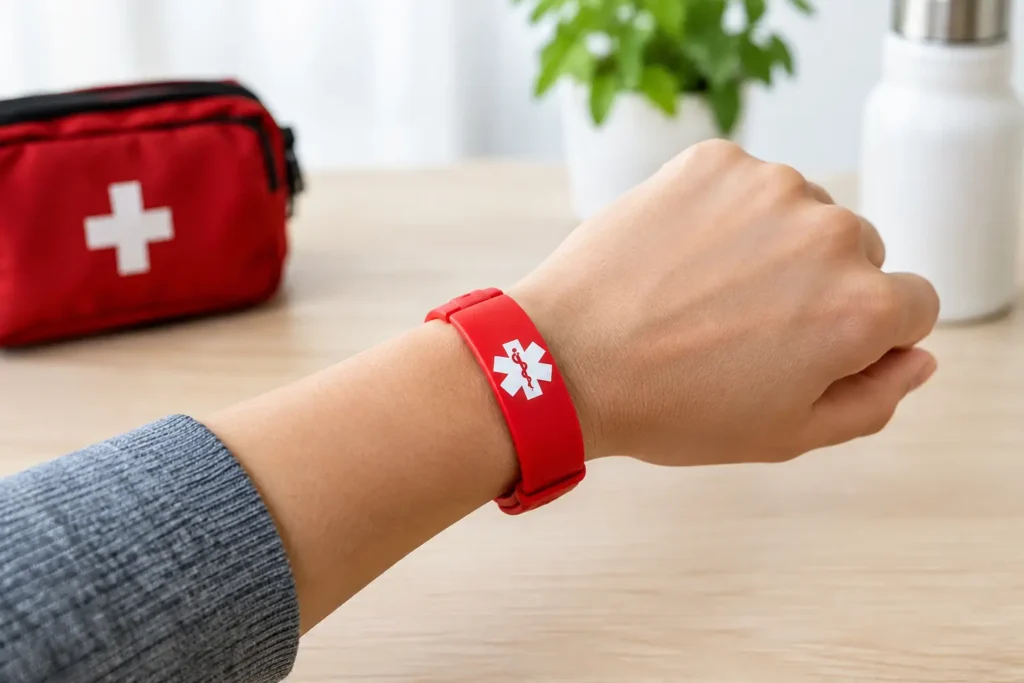
A good emergency wristband review should begin with a difficult but practical question: if Mum fell in the bathroom, felt suddenly unwell in the garden or became confused while out, could she get help without finding a phone, remembering an app or waiting to be noticed? The right wristband provides reassurance without making everyday life feel medicalised or restrictive.
For the person wearing it, the best personal alarm is one they can forget they are wearing. For family members, it is one that works at the moment it is needed, not only when it has been charged, connected and set up correctly. That is why the details behind an emergency wristband matter far more than a long list of features.
An emergency wristband should make it easy to raise an alert when something is wrong. The action needs to be simple enough to use during pain, panic, weakness or confusion. A clearly designed manual SOS function is usually preferable to a tiny screen or a series of menus. If squeezing two buttons sends an alert, the wearer has a straightforward action they can practise and remember.
But a manual alert is only part of the picture. Someone who has fallen may be unconscious, unable to move or too shaken to press anything. This is where automatic fall detection can offer an extra layer of protection. It should be seen as support rather than a promise to identify every stumble. Falls vary considerably, and no system can reliably interpret every movement. The useful question is whether the device is designed to identify severe falls and prompt help when the wearer may not be able to ask for it.
Scheduled check-ins are also valuable for people who live alone. A simple “I’m OK” confirmation at agreed times can help family spot when a usual routine has changed. It is a gentler approach than repeated calls, and it respects the wearer’s independence while giving relatives a clear reason to follow up if no confirmation arrives.
Together, manual SOS, automatic fall detection and check-ins cover different kinds of emergency. One helps when a person can act, one helps when they cannot, and one helps when concern is raised by silence.
Many alarms work well in one room but are less helpful once the wearer goes upstairs, into the garden or leaves home. Coverage is not a technical detail to skim past. It determines whether the wristband will fit real life.
For use at home, a dedicated base station can provide dependable connection around the house and garden. This avoids relying entirely on the wearer’s mobile phone, which may be charging in another room, switched off or tucked in a handbag. Ask how far the wristband works from its base station, whether walls and garden layout affect this, and what happens during a power or connection issue.
Protection outside the home needs equally careful thought. Some products only work within range of a home unit. Others use a smartphone connection, meaning the wearer can stay protected while visiting friends, walking locally or travelling, provided their phone is nearby and connected. This can be an excellent arrangement for someone who already takes a smartphone out, but it may not suit a person who often leaves their phone behind.
Before choosing, picture an ordinary week rather than an ideal one. Consider the shower, the shed, taking the bins out, a visit to the shops, an afternoon with family and a holiday in the UK. The right option is the one that protects the places the wearer genuinely goes.
Bathrooms are a common place for falls, yet some people remove wearable alarms before washing because they are worried about water damage. A waterproof wristband that can stay on in the shower removes one more gap in protection. The same applies overnight. A wristband that is comfortable enough for bed is more likely to be worn when a person needs it.
Comfort is a safety feature, not a luxury. If a band catches on clothing, irritates the skin or feels bulky, it may end up on the bedside table. Look for a secure, unobtrusive design and check whether it is suitable for people with a pacemaker where relevant.
Frequent charging is one of the biggest weaknesses of many wearable safety devices. It creates a familiar problem: the wristband is taken off to charge, then forgotten. The person may be without protection for hours or days, often without realising it.
A long-life battery changes the routine. A wristband designed to run for a full year without recharging is easier to keep on through meals, sleep, washing and everyday outings. It also reduces one task for a person who may already be managing medication, appointments and other equipment.
That does not mean battery life is the only consideration. You should still find out how the device indicates a low battery, who is responsible for replacement and whether there is any interruption to protection. However, an annual battery is generally far more practical than a device that depends on nightly charging.
An alert is only useful if it reaches people who can respond. Depending on the service, this may be family members, trusted friends, carers or a professional monitoring team. Each approach has advantages.
Family-led alerts can feel personal and immediate, especially when relatives live nearby and are happy to share responsibility. Professional monitoring may suit families who cannot always answer their phones or who live a long distance away. Some people prefer a combination, so there is more than one route to help.
Ask what information recipients receive, how quickly alerts are sent and what happens if the first person does not respond. If protection away from home relies on a smartphone, check how the wearer’s location can be shared during an emergency and what the limits are. Clarity before an emergency prevents uncertainty afterwards.
It is also worth discussing the arrangement with the person who will wear it. Agreeing who is contacted can protect dignity and avoid making them feel watched. The aim is not to monitor every movement. It is to make sure help is at hand when it is genuinely needed.
An alarm can look impressive on a comparison table and still be difficult to live with. The most reliable device is usually the one with the fewest demands on the wearer: no daily charging, no need to navigate a touchscreen and no complicated steps before an alert can be sent.
When assessing Acticheck, for example, consider its three ways of raising concern: squeezing the wristband buttons for SOS, confirming scheduled “I’m OK” check-ins and automatic detection of severe falls. Its home base station supports use around the home and garden, while its iPhone and Android apps extend protection beyond home when the phone is nearby. The waterproof, pacemaker-safe wristband is designed to be worn in bed and in the shower, with a full-year battery.
Those features will be particularly useful for a person who wants to remain independent but is not confident with technology. They may be less suitable if the wearer will not keep a smartphone nearby when out, or if a different monitoring arrangement is required. A truthful review recognises both the reassurance a system offers and the habits it depends upon.
Before ordering, make sure you can answer these practical questions. Can the wearer activate it easily with their hands? Will it work in the rooms and garden they use? Can it be worn in the shower and overnight? Does it need charging? Who is alerted, and what happens if they do not answer? What ongoing service costs apply, and is support available if you need help setting it up?
If possible, involve the wearer in the decision and let them try the action several times. A personal alarm should feel like a quiet source of confidence, not a reminder that someone has lost control of their life.
The best choice is not necessarily the wristband with the most features. It is the one your loved one will wear every day, and that gives you both a clear, dependable route to help whenever it is needed.